











Breathing Circuit of an Anesthesia Machine: Components & Function

November 04, 2026
Breathing Circuit of an Anesthesia Machine
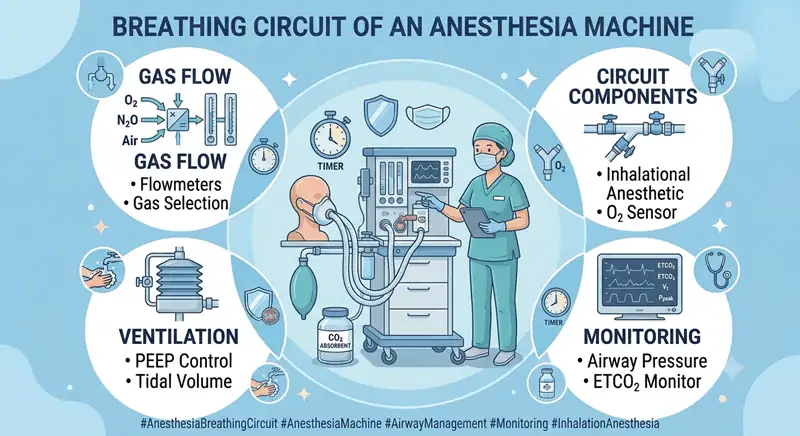
In the field of anesthesia, a breathing circuit refers to the functional system used for the delivery of anesthetic gas and oxygen, as well as for the removal of carbon dioxide. The anesthesia machine is connected to the patient through the breathing circuit, and it has an important function in terms of ensuring the ventilation, oxygenation, and administration of inhalation anesthesia safely.
Knowledge about the function and design of a breathing circuit is important for practitioners of the anesthesia profession, as any problem with the circuit can lead to hazards in terms of ventilation efficiency and the safety of patients undergoing operations.
What Is a Breathing Circuit?
Breathing circuits include the combination of valves, tubes, adapters, and other structural components that allow gases to travel between the anesthesia machine and the patient’s respiratory system. Depending on the particular breathing machine type, either full rebreathing of exhaled gases may happen after removing carbon dioxide or elimination of gases into a garbage system.
Thus, three major functions of the breathing circuit are recognized, i.e., the provision of gas to the patient, removal of carbon dioxide from the respiratory system, and control of the ventilation process or support of it.
Major Components of an Anesthesia Breathing Circuit
Despite the variation arising from circuit types, the most commonly encountered components are mentioned below.
- Breathing Tubes
The flexible, corrugated tubes create a route for gas flow from the anesthesia machine to the patient, allowing the tubes to be bent around the surgical table, thus allowing gas flow to occur.
- Reservoir Bag
The reservoir bag holds a quantity of breathing gas and allows manual ventilation when needed. It also shows if the patient is spontaneously breathing and gives the anesthesia technician useful information on how the patient is breathing.
- Unidirectional Valves
Unidirectional valves are included in most breathing systems to control the direction of gas flow. These valves have to be working properly so that exhaled carbon dioxide does not return to the patient.
- Carbon Dioxide Absorber
The carbon dioxide absorber is one of the most important components of a breathing circuit because it is responsible for removing carbon dioxide from the gases exhaled by the patient. Soda lime is often used as an absorbent.
- Y-Piece
The Y-piece connects the inspiratory and expiratory limbs of the breathing system to the patient’s lungs.
How Does a Breathing Circuit Work?
The circle system of a breathing circuit functions in a cycle of inspiration and expiration. During the process of inspiration, a combination of fresh gases is supplied to the patient along with the exhaled gas that is reused depending on the specific equipment and flow rate of the fresh gas. The exhaled gases from the patient pass through the exhalation line to the carbon dioxide absorbent, which absorbs carbon dioxide before any other gas enters the inhalation line.
The system continuously adds fresh oxygen and anesthetic gases into the system in order to replace the gases that have been consumed by the patient. Any excess gases are released through the valve, which leads into a collection area. This system allows for partial rebreathing but avoids having excess levels of carbon dioxide.
What to Focus Upon While Checking the Functioning of a Breathing Circuit?
Before commencing anesthesia, it is essential to carry out an extensive check of the breathing circuit. The presence of any problems in the breathing circuit can lead to inadequate ventilation, hypoxia, high airway pressure, and possible exposure to any anesthetic gases used on the patient. Some of the checks to do include:
- Check both the tubing and the connectors for damage.
- Check for leaks or disconnects.
- Confirming correct attachment of both the inspiratory and expiratory limbs are correctly attached.
- Unidirectional valves are assessed.
- Confirming proper functioning of the APL valve.
- The carbon dioxide absorber is checked.
- Leak checks and system checks recommended by the manufacturer.
Conclusion
The breathing circuit is the essential link between the anesthesia machine and the patient’s respiratory system. It provides the required means for oxygen and anesthetic gases delivery and carbon dioxide elimination, thereby permitting controlled ventilation throughout the anesthesia.
Among available systems, the widely used circle breathing system allows rebreathing after carbon dioxide absorption, thus allowing minimization of the quantity of fresh gas and anesthetic used. Other systems like Mapleson and Bain circuits and the Jackson-Rees system are used depending on the patient’s age and needs.
Good knowledge about the components and operating principles of the breathing circuit is necessary for performing equipment checks, as well as for providing continuous monitoring of patients in order to ensure effective ventilation of the patient.
Build Your Expertise in Anesthesia Technology with DPMI Vocational Institute
If you are someone who is interested in establishing a reputation in the field of healthcare and the diagnostic industry in the next five years, you should enrol in the paramedical courses available at DPMI Vocational Institute. The courses are highly dynamic and have an expanding scope in India as well as abroad in the upcoming years.
The eligibility criteria for enrolling in various courses offered at DPMI Vocational Institute are that one should have completed 10th or 12th grade and be willing to dedicate one to three years to the course. The curriculum of the course revolves around topics such as working with medical equipment, analysing samples, and supporting doctors in disease diagnosis. Enroll today for a successful future ahead!